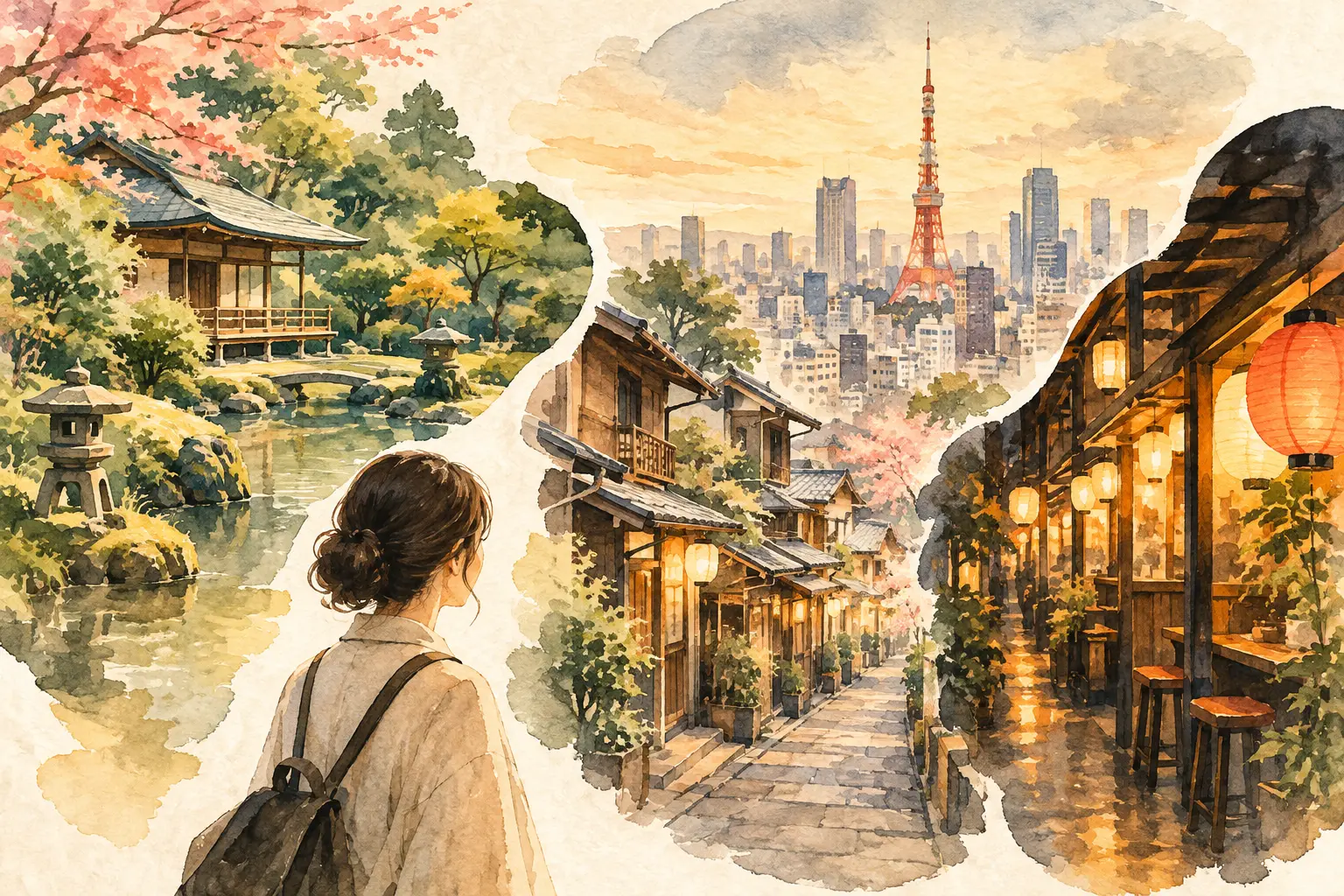
Tokyo does not have one center that explains the whole city. It has many centers, each with its own rhythm: temple streets that wake early, station districts that stay busy late, quiet residential lanes, fashion crowds, office towers, and tiny bars behind unassuming doors. Choosing between Tokyo neighborhoods is less about finding the one “best” area and more about deciding how you want your days to feel.
A hotel near a major station can make a short trip easier. A room in a calmer district can make Tokyo feel less intense when you come home at night. The right choice depends on your interests, your group, your tolerance for walking, and whether you want to be out for dinner at 10 p.m. or asleep before the last train becomes relevant.
| Area | Best fit | Main trade-off |
|---|---|---|
| Asakusa | Temple streets, local atmosphere and early starts | Longer journeys to western Tokyo |
| Ueno | Museums, markets and convenient east-side exploring | Busy streets around the station |
| Shinjuku | Wide transport connections, dining and lively evenings | A large station that takes time to navigate |
| Shibuya / Harajuku | Shopping, cafés, fashion and contemporary culture | Crowded streets in popular areas |
| Ginza / Imperial Palace area | Central access, architecture and a more composed atmosphere | Less of a casual neighborhood-bar feel |
| Akihabara | Anime, gaming, electronics and collecting | A more specialized atmosphere for a first stay |
Tokyo neighborhoods at a glance
- AsakusaTemples & traditional streets.Allow longer trips to west Tokyo.
- UenoMuseums, markets & east Tokyo.Busy around the station.
- ShinjukuTransport, dining & nightlife.A large station to navigate.
- Shibuya / HarajukuShopping, fashion & cafés.Expect crowds.
- Ginza / Imperial PalaceCentral, with a calmer atmosphere.Less of a casual local-bar feel.
- AkihabaraAnime, gaming & electronics.A more specialized base.
Start with the shape of your Tokyo trip
Tokyo looks compact on a map until you begin connecting plans across it. A morning in Asakusa, an afternoon in Harajuku, and dinner in Shinjuku are perfectly possible, but they are not a casual stroll between neighboring blocks. Rail travel is efficient, yet stations are large, transfers take time, and a day becomes less enjoyable when every hour is spent chasing the next stop.
For a first visit, choose an area that matches the majority of your plans rather than trying to position yourself equally close to everything. There is no such location. Staying in Shinjuku makes sense if you want easy access to evening energy and broad train connections. Staying near Ueno or Asakusa suits travelers who like older streets, museums, markets, and a softer start to the day. Shibuya and Harajuku work well if contemporary fashion, youth culture, cafés, and people-watching are high on the list.
If you are traveling with children, older relatives, or anyone who prefers a gentler pace, the immediate surroundings matter as much as the train map. A hotel a few minutes from a station may sound minor, but those extra minutes can feel long after a full day on your feet, especially in summer rain or with shopping bags in hand.
Renaud's practical tip: before choosing a hotel, I recommend checking three journeys from its exact entrance: your arrival with luggage, your first planned visit, and your return after dinner. Look at the station entrance and the line you will actually use, not just the nearest station pin. If stairs are a concern, check the route with elevators too. Tokyo Metro's guide to station exits is a useful starting point. If lines, gates and exits are still unfamiliar, our practical guide to using the Tokyo subway explains the essentials.
The Tokyo neighborhoods travelers ask about most
Asakusa: traditional atmosphere without leaving the city
Asakusa gives many first-time visitors the Tokyo they had pictured: a major Buddhist temple, incense in the air, narrow shopping streets, small eateries, and views toward the Sumida River. It can be busy around the main approach, particularly during the day, but a few streets away the mood changes quickly.
This area suits travelers who want a historic atmosphere close to their hotel and who do not need a late-night entertainment district outside the door. It is also a useful base for combining temple culture with Ueno, where museums and parkland offer a different kind of day. The trade-off is that some western and southern parts of Tokyo require longer journeys.
Asakusa is not a frozen version of old Japan, nor should it be treated as one. The better experience comes from mixing the famous temple area with quieter side streets and understanding what still functions as a neighborhood rather than simply a backdrop for photos.
Ueno: practical, lively, and well connected
Ueno is often an excellent choice for travelers who value convenience over polish. Its large station makes getting around straightforward, while the area around the park offers museums, greenery, and a welcome break from dense commercial streets. Nearby market lanes have a lively, slightly rough-around-the-edges character that many visitors enjoy.
It is especially practical for families, first-time visitors, and travelers who want access to the east side of the city without staying in a purely tourist-focused district. It can feel busy around the station, and it does not have the glossy, late-night energy of Shibuya or Roppongi. For many people, that is exactly the point.
Shinjuku: broad connections and lively evenings
Shinjuku is a strong base if you want Tokyo at full volume. The station area is enormous, the dining choices are broad, and trains reach much of the city with relative ease. It works particularly well for short stays, groups with different interests, and travelers who like having restaurants, department stores, casual bars, and bright city streets close by.
The compromise is sensory overload. Shinjuku is not one single experience. West Shinjuku has towers, hotels, and a more businesslike feel. East Shinjuku is busier and more entertainment-driven. Small lanes can be atmospheric, while the main roads can be loud and crowded. Choosing a hotel a little away from the station chaos often makes a significant difference.
At night, Shinjuku can be great for an evening built around food, relaxed drinks, cocktail bars, or music. Kabukicho is nearby, but it is not a mandatory stop and does not suit every traveler or group. A good night out should reflect your comfort level and budget, not a postcard idea of Tokyo after dark.
My advice for staying in Shinjuku: save your hotel's map pin and the station exit that fits your route before heading out. “Near Shinjuku Station” does not tell you how far you will walk inside the station. For a late evening, check the last connection for your exact route that day, and decide whether you would be comfortable walking back or taking a taxi. To make the most of Shinjuku after dark, our private nightlife tour with a local insider helps you discover the bars and venues that match your style.
Shibuya and Harajuku: fashion, energy, and easy people-watching
Shibuya is for travelers who want to step outside and feel immediately connected to contemporary Tokyo. The famous crossing is only one small part of it. There are department stores, casual restaurants, design shops, music, side streets, and plenty of movement at almost every hour.
Harajuku and Omotesando, within easy reach, offer a useful contrast. Harajuku has playful fashion and youthful crowds, while Omotesando feels more architectural and polished, with broad avenues and quieter back streets. A route through these areas can be satisfying because it changes character block by block.
This part of Tokyo is ideal for couples, friends, and returning visitors who enjoy shopping, street culture, and café breaks. It may be less appealing if you are looking for traditional scenery at your doorstep or if packed sidewalks quickly drain your energy. Hotel rooms can also be smaller or more expensive in popular locations, so compare the room itself, not just the pin on the map.
Ginza and the Imperial Palace area: central and composed
Ginza is known for refined shopping, department stores, galleries, and restaurants, but it is also a practical central base for travelers who prefer a more composed atmosphere. The streets are comparatively calm late at night, and several train lines make it easy to reach other parts of the city.
Nearby, the Imperial Palace area offers broad avenues, open space, and a different view of Tokyo's scale. It is well suited to travelers who enjoy architecture, gardens, and central access without needing nightlife immediately outside their hotel.
The trade-off is personality. Ginza can feel less casual than Ueno or Asakusa, and it is not where most visitors go for a scruffy, spontaneous bar crawl. That is not a criticism. It simply helps to know what kind of evening you want before booking.
Akihabara: more than a niche stop, but still a niche base
Akihabara is a natural destination for anime, gaming, electronics, and collector culture. It can be a fun place to explore, and its location is more central than many visitors expect. As a hotel base, though, it depends on how much that particular atmosphere matters to you.
For a focused interest, staying nearby can be convenient. For a broader first trip, many travelers prefer to visit Akihabara for a few hours and stay somewhere with more varied morning and evening options. The district's bright commercial face is only one side of Tokyo, so give yourself room to see the others too.
Build days around neighboring areas, not a checklist
The most enjoyable Tokyo itineraries usually connect two or three compatible areas rather than cramming in six famous names. Asakusa and Ueno make sense together. Harajuku, Omotesando, and Shibuya can form a full day with very little wasted travel. Shinjuku can pair with quieter nearby streets or parks instead of becoming an all-day station-area marathon.
This is where local context helps. A shrine, a food stop, a department-store basement, and a quiet lane may sit within the same broad area, but their opening times and walking distances shape the day. Weather matters too. On a hot or rainy day, a route that looks charming on paper can become ambitious very quickly.
With a private day tour, we can shape the route around what you actually enjoy, whether that means temple streets and local food, contemporary architecture and shopping, or a balanced introduction to several sides of the city. Tours use walking and public transportation, so the plan should stay realistic rather than pretending Tokyo is a theme park with everything next door.
A simple way to choose your base
Ask yourself three questions before booking: Do you want quiet nights or easy nightlife? Are historic streets, museums, shopping, or food the priority? And how much transit are you happy to do each day?
If your answers lean toward temples and a relaxed local feel, look at Asakusa or Ueno. If you want major connections and evenings with plenty of options, Shinjuku is hard to beat. If style, restaurants, and modern city energy matter most, Shibuya or the Harajuku area may suit you better. For a central, calmer base, Ginza and the Imperial Palace area deserve a close look.
The good news is that you do not need to choose one version of Tokyo for the entire trip. Pick a base that makes daily life easy, then let the rest of the city come to you one neighborhood at a time. If you would like help turning your interests into a manageable private route, Japan BTO can discuss what fits your dates, pace, and preferred side of Tokyo.