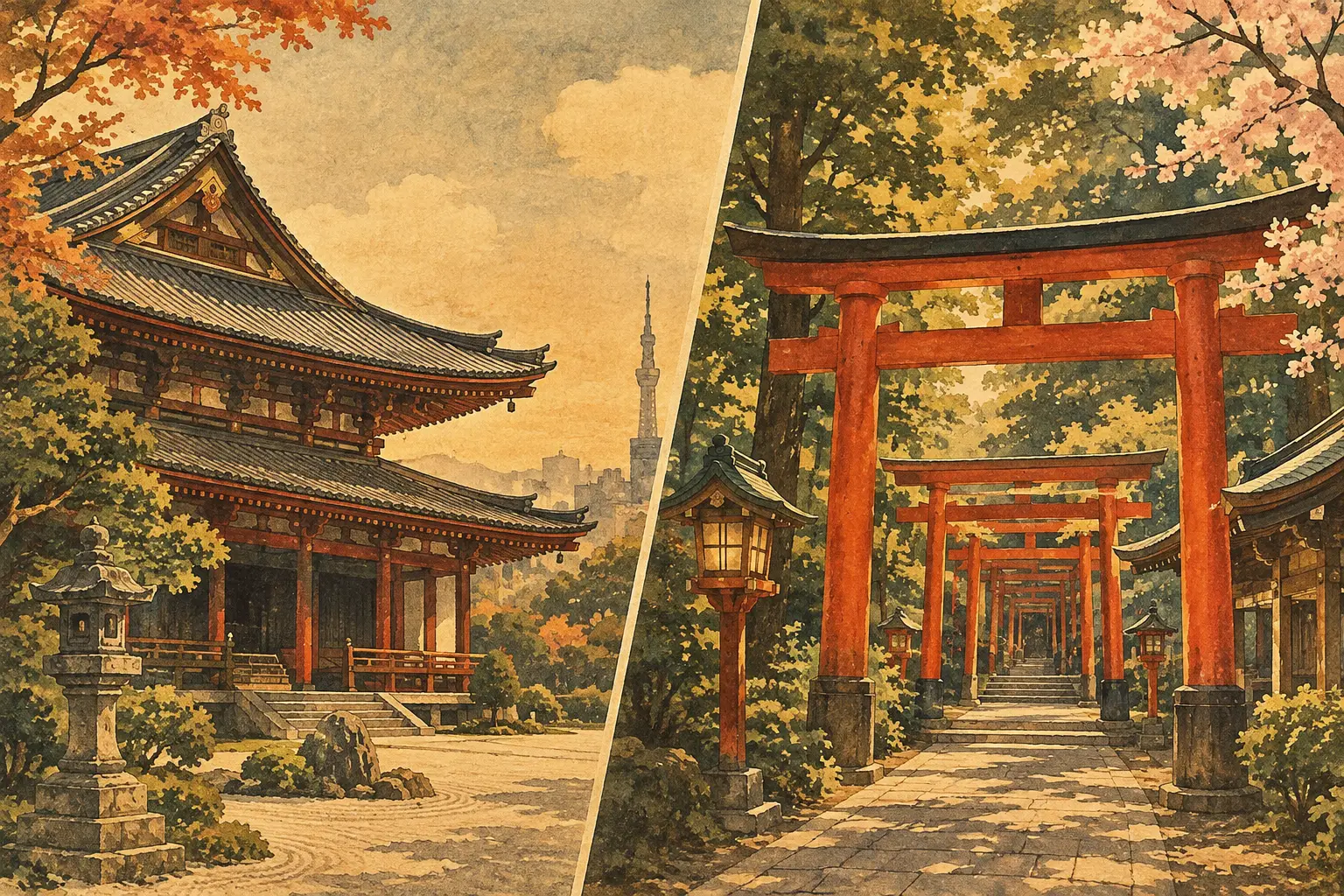
A red torii gate, a cloud of incense, a quiet hall where people clap twice - Tokyo can make temple and shrine visits look similar at first. Understanding Tokyo temple shrine differences helps you notice what is happening around you, follow local etiquette with more confidence, and choose stops that suit the kind of day you want.
The short answer is simple: temples are generally Buddhist, while shrines are generally Shinto. The more useful answer is that both are active places of worship, both are woven into ordinary Tokyo life, and the line is not always as tidy as a first-time visitor might expect.
Tokyo temple shrine differences at a glance
A temple is called tera in Japanese and is connected with Buddhism. You may see statues of Buddha or Buddhist figures, incense burners, a main hall, a cemetery, or sometimes a pagoda. Temples are often places people associate with memorial services, funerals, and prayers related to ancestors, although their role is much broader than that.
A shrine is called jinja and is connected with Shinto, Japan's native spiritual tradition. Shrines honor kami - a word often translated as gods or spirits, though neither English term catches the full meaning. Kami may be linked to nature, a place, an ancestor, a historical figure, or an idea such as learning, safe travel, or prosperity.
The most recognizable clue is usually a torii, the gate that marks the approach to a shrine. At a temple, you are more likely to enter through a substantial wooden gate, often called a sanmon, rather than a torii. But Tokyo enjoys exceptions. Some sites have features that make visitors pause and wonder, and history is the reason.
For many centuries, Buddhism and Shinto were deeply intertwined in Japan. Their formal separation was pushed by government policy in the late 19th century, but shared customs and visual echoes did not vanish overnight. So treat the labels as helpful guidance, not a pop quiz.
What you will notice when you arrive
At a shrine, the approach itself is part of the experience. Passing under the torii signals that you are entering a sacred space. Walk to the side of the path rather than directly down the middle, which is traditionally reserved for the kami. A small bow before passing through the gate is a thoughtful gesture, not a theatrical performance.
Many shrines have a water pavilion, known as a temizuya or chozuya, near the entrance. Visitors use the ladles to rinse their hands before approaching the main hall. The usual order is left hand, right hand, then a little water into the left hand to rinse your mouth. Do not drink directly from the ladle, and do not return water from your mouth to the basin. If the water pavilion is closed or there is a sign asking visitors not to use it, simply continue on.
Temple grounds often have their own purification point, but incense is the more obvious visual cue. At Senso-ji in Asakusa, visitors gather around a large incense burner before the main hall. Some gently waft the smoke toward themselves as a customary gesture of purification or good health. It is fine to observe first and follow the pace of the people around you rather than turning it into a smoke-bathing competition.
You may also find a bell at a temple. In some places, visitors ring a bell before praying; in others, it is not for public use. Follow any posted instructions and do not assume every rope, bell, or doorway is there for visitors to use.
Prayer is similar in spirit, different in form
At many Shinto shrines, a common prayer sequence is two bows, two claps, a quiet personal prayer, then one final bow. This is a useful rule of thumb, especially at major shrines, but signs at the site take priority.
At Buddhist temples, people generally place a small offering if they wish, join their hands quietly, and pray without clapping. Again, customs differ by temple and Buddhist school. You do not need to know every gesture perfectly. A calm, observant approach is far more respectful than performing a ritual at top speed because a guidebook told you to.
The Tokyo examples that make the distinction clear
Senso-ji, Tokyo's well-known Buddhist temple in Asakusa, is an excellent first stop because the layout makes temple features easy to spot: the grand gate, the incense burner, the main hall, and the surrounding lanes that have welcomed worshippers and visitors for generations. It can be busy, particularly during popular travel periods, but it remains a functioning religious place rather than a museum set.
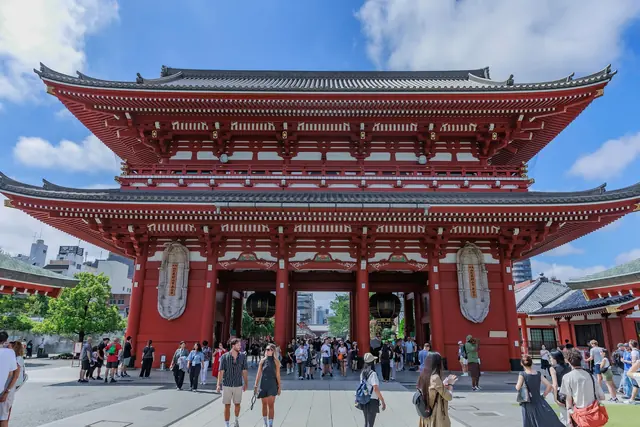
Just beside it sits Asakusa Shrine, a Shinto shrine. Visiting the two together is one of the clearest ways to understand how closely temple and shrine traditions can sit beside each other in Tokyo. The mood changes subtly: architecture, prayer customs, and the objects around the grounds give you different clues, even within a few minutes' walk.
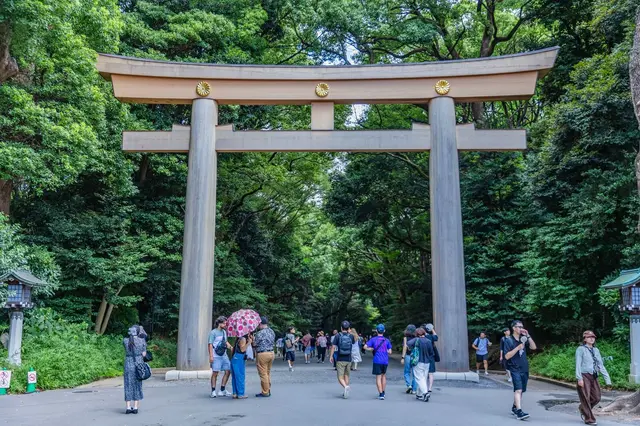
Meiji Jingu, near Harajuku, offers a contrasting shrine experience. Its broad forested approach can feel surprisingly removed from the nearby shopping streets. This is a good choice if you want space, large-scale shrine architecture, and a quieter rhythm than the commercial energy around Takeshita Street.
For a temple visit with a more neighborhood-centered feel, smaller sites around Yanaka, Ueno, or central Tokyo can be rewarding. These stops tend to work best when they are part of a route with a clear shape - perhaps a morning market, a park walk, a local lunch, and one or two religious sites - rather than an attempt to collect every famous name before dinner.
Nezu: understanding Inari’s torii and foxes
Nezu-jinja also contains Otome Inari and Komagome Inari, two smaller Shinto shrines. The row of donated torii leads to Otome Inari. These gates make a striking photograph, but they are also religious offerings.
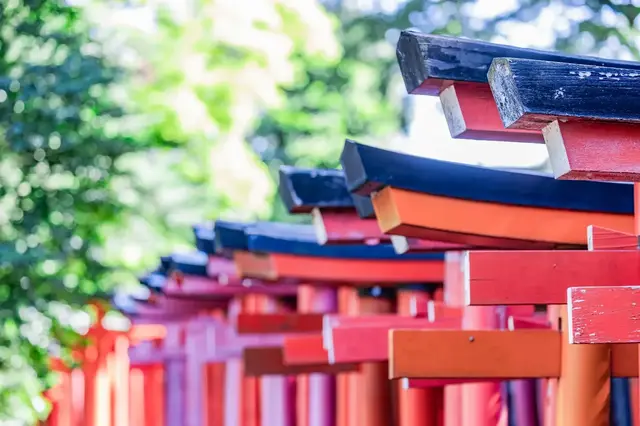
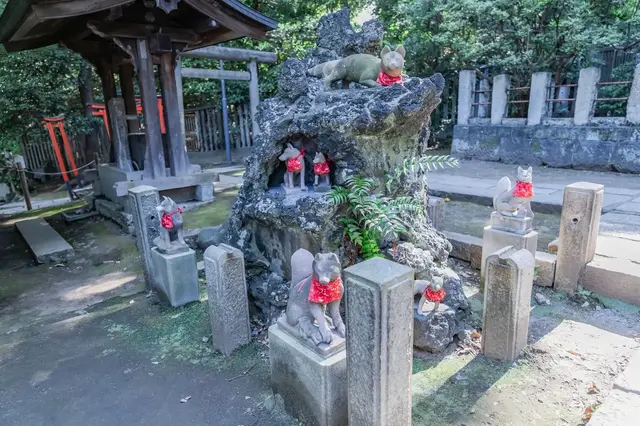
Inari is associated with harvests and prosperity. The fox statues represent Inari’s messengers; Inari is not a fox. In the Inari tradition, torii may be offered with a prayer or in gratitude for a wish fulfilled. Looking at these details turns a scenic stop into a better understanding of the place.
Do not judge by the souvenir stall
Both temples and shrines sell items connected to prayer and good fortune. You may see omikuji, paper fortunes, and ema, wooden plaques on which visitors write wishes. If you receive an unfavorable fortune, many sites provide a place to tie it up, symbolically leaving the bad luck behind. If you receive a favorable one, you may keep it or tie it up according to the custom at that location.
You may also notice omamori, small protective amulets. These can relate to health, exams, travel, business, relationships, or safe driving. Buying one is optional. They are religious objects, not Tokyo souvenirs with a mandatory checkout step, so choose one only if it has meaning for you.
At temples, you may have the chance to receive a goshuin, a hand-brushed temple or shrine stamp in a dedicated book. This is a lovely record for travelers who enjoy calligraphy and religious architecture, but it should be treated respectfully. A goshuin book is not a passport for attraction stamps. Some sites have specific reception hours, some cannot offer stamps during ceremonies, and some ask that visitors do not bring books associated with the other tradition. A little patience goes a long way.
Etiquette that works almost everywhere
The practical rule is to slow down at the threshold. Keep your voice low near worship halls, follow photography signs, and avoid blocking the route of people who have come to pray. Never photograph inside a hall unless it is clearly permitted. At busy sites, take your photo, step aside, and let the next person have a view.
Dress does not need to be formal for most Tokyo temple and shrine visits. Clean, comfortable clothing and shoes suitable for walking are usually the sensible choice. You may be asked to remove shoes in certain buildings, so socks without holes are a modest but useful bit of travel planning.
If a ceremony is underway, watch quietly from a respectful distance unless staff indicate otherwise. You do not need to understand every word to appreciate the atmosphere. The aim is not to imitate worshippers but to be a considerate guest in a place that matters to them.
Planning a temple and shrine day without rushing it
A temple-and-shrine route works best when it has contrast. Asakusa can pair naturally with the older streets around it and a food stop. Meiji Jingu can fit with Harajuku and Omotesando, where the shift from forest paths to contemporary architecture tells a very Tokyo story. Ueno can combine green space, museums, and smaller religious sites, but it can become too ambitious if you try to add Asakusa and Shibuya on the same day.
Travel time matters more than a map makes it appear. Tokyo's trains are efficient, but finding the right platform, navigating a large station, and walking through a temple precinct all take time. For most visitors, two major religious sites with room to pause is more satisfying than five rushed photo stops.
If you are traveling with children, older relatives, or anyone who prefers a gentler pace, choose one main site and build the day around it. A quiet temple street, a café break, and a neighborhood wander often leave a stronger impression than another long train ride.
Tokyo's temples and shrines are not competing categories to tick off. They are different windows onto the city: one shaped by Buddhist practice, the other by Shinto traditions, both still present in daily life. If you would like help fitting the right mix of religious sites, neighborhoods, food, and walking into a private Tokyo day, we are happy to discuss a route at a pace that feels right for your group.